- Compute equivalent
- A compute equivalent is an operating asset with a liquid rental market under it.
- Short-term GPU contract
- A short-term GPU contract is an agreement under which an idle GPU-hour sells at a known price.
- Pre-emption right
- A pre-emption right is a term letting the owner reclaim capacity on 24 hours' notice with a service credit, not a damages claim.
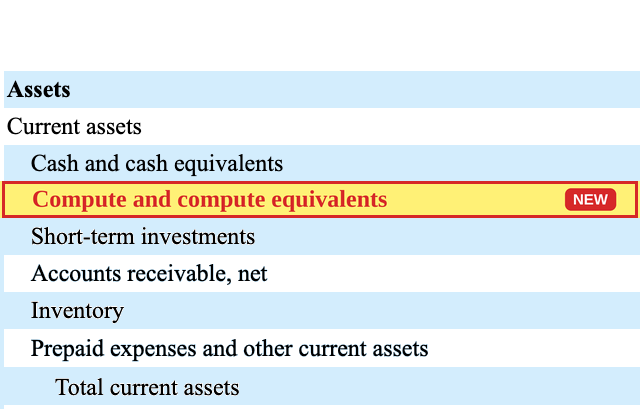
Every cash-rich company manages its balance sheet the same way. Cash and cash equivalents sit in Treasury bills, money market funds and short-term bonds. A three-month bill pays 4.00% today and a one-year bill 4.24%. Below that line the categories have not changed in a century: receivables, inventory, property, plant and equipment, intangibles. Nothing in that list treats compute as something a treasurer holds.
It should. Below "cash and cash equivalents" there belongs a second line: "compute and compute equivalents." An idle GPU-hour now sells on a short-term contract at a known price, which puts it closer to a bill than to anything else in PP&E. A company with a strong cash balance and proprietary data should hold part of its treasury as compute, because the same dollar that earns 4% in a bill can earn a multiple of that in a rack while running the company's own science in between.
Here is the math for a hypothetical mid-cap pharma with $8B of revenue and $2B of cash earning roughly $80M a year in bills. It finances eight GB300 NVL72 racks, 576 GPUs, for a $9.6M equity cheque, 0.5% of its cash. It runs the cluster half the time for its own science and sells the idle hours on short-term contracts. In year one the resale income is $22.3M against $10.9M of debt service. After tax the cluster returns $10.9M of cash on that $9.6M cheque in its first year. The same $9.6M in one-year bills returns $0.4M. The compute return is levered and carries operating risk, which is exactly why it needs its own line rather than a seat in the cash line. Over five years the company spends $23M for compute that would cost $85M rented.
The spreadsheet is attached. Every input is a blue cell.
Lilly, Roche and BMS already keep proprietary biology off shared clouds
LillyPod went live in Indianapolis in February 2026 with 1,016 Blackwell GPUs training protein diffusion, small-molecule and genomics models on data Lilly will never upload to a hyperscaler. Roche runs 2,176 on-prem Blackwell GPUs. BMS has run a 1,016-GPU SuperPOD for three years and is expanding onto Vera Rubin. The training set is the company, so the compute sits inside the company. Large-cap pharma can carry that as a cost centre and eat the idle time. A mid-cap cannot, and does not have to.
The cluster: 8 racks, 576 GPUs, 1.3 MW, $47.9M, no new building
A GB300 NVL72 rack costs about $5.0M and roughly $5.7M deployed with networking and integration in an AI-ready colo. Eight racks plus 5% for spares and software is $47.9M. At 140 kW per rack and a PUE of 1.2 the whole thing needs 1.3 MW of liquid-cooled colocation. At $250 per kW per month plus power at $0.10 per kWh, colocation runs $530K per rack per year, $4.2M for the cluster. Total operating costs with staff, support and insurance: $8.0M a year. This is a colo contract and a purchase order, not a data centre project.
Benefit one: the pharma borrows at 5.25%, the neocloud selling it compute borrows at 12% or worse
The company funds 80% of the capex, $38.3M, with ordinary investment-grade corporate debt at 5.25% amortising over four years. Annual debt service: $10.9M.
Compare the lender's view of a neocloud. CoreWeave's first GPU-backed loan in 2023 cost about 15%. Its July 2025 facility priced at SOFR plus 4.00%. Its best-ever deal, $8.5B in March 2026, needed a $19B Meta backlog to reach SOFR plus 2.25%. Everyone without a hyperscaler offtake behind them is borrowing at 12% or worse.
Be precise about where this shows up. The savings in the model come from two numbers only: the pharma's total cost of ownership, including its 5.25% debt service and $8.0M of operating costs, against the market rental rate it avoids paying. The neocloud's 12% is not a separate line in the savings. It is already inside the $11 to $13 rental price, because the neocloud has to recover it. The spread is the reason the rental market sits above an investment-grade company's cost of owning the same rack, which is the arbitrage this whole article is about. Had the pharma borrowed at 12% itself, its debt service would be $12.6M instead of $10.9M and its owned cost would rise $0.69 per internal GPU-hour. The enterprise balance sheet is the cheapest capital in the GPU market and almost nobody is using it that way.
Benefit two: the One Big Beautiful Bill Act lets the company expense all $47.9M in year one
The One Big Beautiful Bill Act, signed 4 July 2025, permanently restored 100% bonus depreciation under section 168(k) for qualified property acquired and placed in service after 19 January 2025, and IRS Notice 2026-11 (14 January 2026) confirmed the rate is set at 100% indefinitely. GPU racks are five-year MACRS property. The pharma deducts the full $47.9M in the year it goes live. At 21% that is $7.5M of federal tax saved in year one, against $5.8M for a company deducting cloud rent as it goes.
Put the two together. After tax, the cluster generates $10.9M of positive cash flow in year one, after paying its debt service and its operating costs. The cloud route costs $21.9M after tax in the same year for the same internal workload.
Benefit three: idle hours sell for $13 on short-term contracts and that pays for everything
Internal utilisation is 50%: training campaigns run hot for weeks, then the team analyses results while racks idle. That is not pessimistic. Published rent-versus-buy analyses put measured enterprise GPU utilisation at 35% to 55%, and Cast AI's 2026 report found 5% average GPU utilisation across 23,000 production Kubernetes clusters on AWS, GCP and Azure. The model sells 80% of the idle hours on short-term contracts and loses the rest to maintenance, pre-emption buffer and re-imaging. Net, 40% of all GPU-hours are sold, 2.0M a year.
GB300 short-term contract pricing is about $13 a GPU-hour today. Public rental indices do not list GB300 yet; it is quote-only at most clouds, so treat $13 as a scarcity price. After a 15% channel fee that is $22.3M of year-one revenue, 205% of debt service and 2.8 times the $8.0M of operating costs. The model cuts the price 25% a year from there, so year five is $4.11.
The comparison that matters is cost per internal GPU-hour. Renting a GB300 on a one-year reserved contract at $11 costs $27.8M in year one. Owning with no resale costs $11.27 an hour once the equity cheque is charged up front, slightly worse than cloud. Owning with resale costs $2.43.
That is the whole argument. A pure cost-centre cluster is a coin flip against cloud: break-even utilisation is 51% and the assumption is 50%, which matches the 40% to 77% break-even range in the rent-versus-buy analyses that circulate today. Those analyses stop there. None of them count idle-hour resale, bonus depreciation or balance-sheet financing, which is why they conclude most companies should rent. Over five years the no-resale cluster loses to cloud by $6M. The resale cluster beats it by $62M. After tax and discounted at 8%, owning carries a $41M NPV advantage. The idle hours are not a side business. They are the return on the asset.
The sensitivity table shows how far the price can fall before this breaks. At $6 an hour and only 25% of hours sold, year-one owned cost is $8.72, still 21% under cloud. Short-term pricing can lose half its value and the thesis holds.